
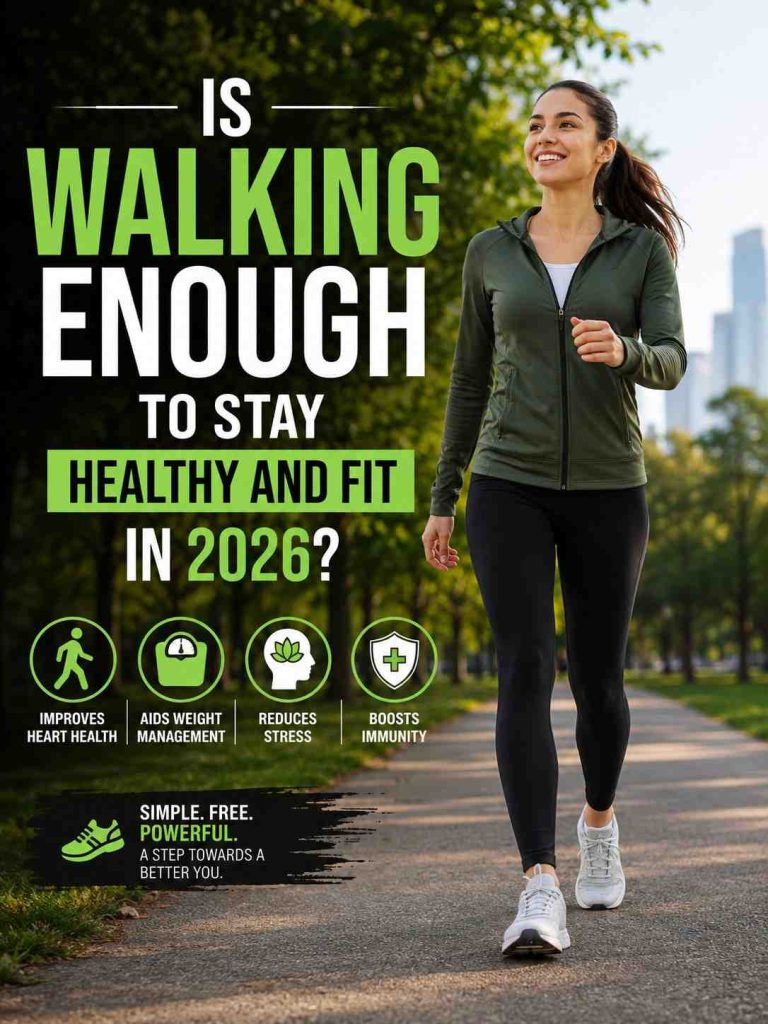
Is walking enough to stay healthy and fit in 2026? Discover walking benefits, ideal activity levels, weight management tips, and why strength training matters.
The definition of fitness is the body’s ability to carry out activities of daily living, physical activities, and exercises with energy and endurance. Fitness includes mobility, coordination, balance, flexibility, endurance, and strength. Health is the total wellness of the body and mind. It is based on nutrition, physical activity, rest, stress control, water, and good habits.
Fitness focuses on engaging in physical activity, while health is about the whole person’s body and mind. They both help achieve a better quality of life. A healthy, active life can keep energy up. It can also help a person avoid excess weight. Muscles and bones tend to stay stronger with regular movement. A person may feel better and stay safer from some illnesses as well.
Is Walking Enough to Stay Healthy and Fit in 2026?
Walking is an easy and simple exercise and a way of being fit and healthy. It will improve your stamina, keep you moving, improve your heart’s condition, and help you control your weight. However, just walking is not sufficient when it comes to attaining fitness because it will not provide enough resistance for strengthening your upper body and muscles.
Walking, strength training, flexibility, balance, and nutrition are essential factors when it comes to maintaining fitness. It will help ensure that he or she is fit and healthy in the year 2026.
How Much Should You Walk in 2026?
There is no such number of steps that everyone should achieve. A ten-thousand-step target is a good motivational target, but it is not a medical necessity for good health. One should not worry about just achieving the number of steps; rather, one should consider:
- How often you walk
- How long you walk
- How fast you walk
- How active you are throughout the day
- Whether you include other forms of exercise
A wise strategy would be to begin with what’s doable and to slowly increase your walking time and intensity.

Walking Intensity Matters
The easy walk does not require the same level of work from your body as the brisk walk. Walking at an easy pace can help improve activity levels and may even be used by people during recovery or as beginners. Quick walking leads to an increase in breathing rate and heart rate; hence, increased cardiovascular exercise.
Exercising while climbing up hills will make it difficult, which means that your legs and cardio will be improved through this. So if walking is your primary form of exercise, you can maximize the results of your walk by varying the speed, distance, location, and/or length of time.
What Are the Health Benefits of Walking?
The possible health benefits of walking include the following:
1. Supports Heart Health
Walking is a way of exercising aerobically. Physical activity and exercise can help you to improve your cardiovascular fitness and stay physically active. Walking at a brisk pace will be of particular benefit as it will require more oxygen than sitting or slow walking.
2. Helps With Weight Management
Walking is an activity that helps burn calories, and it can be part of the program for losing weight. However, without walking, there will be no weight loss. There are other factors like body structure, calorie consumption of calories, nutrition, exercise, and sleeping, which are equally significant. In relation to weight loss, it would be better to walk and exercise with a proper diet.
3. Improves Muscular Endurance
Walking involves muscles in your:
- Legs
- Glutes
- Calves
- Core
- Hips
Walking up an incline or stairs adds to the intensity of this exercise and challenges your lower body muscles even further.
4. Supports Bone Health
Weight-bearing exercises like walking can help keep your bones healthy. This is especially true as you get older. Walking is not necessarily the only form of exercise that you need. Other forms of exercise, such as resistance training, can provide further benefits.
5. Supports Mental Wellbeing
Walking serves as an opportunity to get away from work, computer work, and sitting for prolonged periods. It is good to walk outside and feel nature, to get rid of the stress due to routine life. Some people may find it easier to have walking time in their schedules.
6. Improves Everyday Mobility
Consistent movement will make it possible to practice your daily activities like walking, ascending staircases, standing, and changing directions. Being mobile becomes more essential with age.
Walking vs Running: Which Is Better?
Neither method is necessarily better than the other.
| Factor | Walking | Running |
| Impact | Lower | Higher |
| Accessibility | Very high | Moderate |
| Cardiovascular challenge | Moderate when brisk | High |
| Beginner-friendly | Excellent | May require progression |
| Equipment needs | Minimal | Minimal |
| Joint loading | Generally lower | Generally higher |
| Weight-management support | Yes | Yes |
| Muscle-building ability | Limited | Limited |
| Strength training replacement | No | No |
Walking is a type of exercise that is easy to maintain because it causes little stress on your body and is easy to include in your daily activities. It may be possible that jogging would serve as a better cardiovascular exercise, but it does not suit everybody.
A Simple Walking and Fitness Routine
A balanced weekly routine can be developed without having to spend long hours at the gym.
| Day | Activity |
| Monday | 30-minute brisk walk |
| Tuesday | Strength training + easy walking |
| Wednesday | 30–45-minute walk |
| Thursday | Mobility + easy walk |
| Friday | Brisk or incline walk |
| Saturday | Longer recreational walk |
| Sunday | Rest or gentle movement |
This is just an example; your personal routine needs to correspond to your current fitness, schedule, and goals.
Who Can Benefit Most From Walking?
Walking will be especially helpful for those who:
- New to exercising
- Have a sedentary way of life
- Like low-impact exercises
- Want something simple to exercise daily
- Are looking for a convenient way to do aerobic exercise
- Like outdoor activities
- Wish to be more physically active each day
- Like doing exercises without using the gym
For individuals suffering from certain health issues, it is advisable to seek advice from a health practitioner on the appropriate physical activity level.
Is Walking Enough to Lose Weight?
Walking is helpful for losing weight, but walking itself doesn’t necessarily result in fat loss. Your body’s weight depends on its energy balance. If you constantly get more energy from food than you need, walking may not give you the weight loss effect you want. To maintain weight effectively, it is advisable to combine:
- Regular walking
- A balanced diet
- Adequate protein and nutrient intake
- Strength training
- Sufficient sleep
- Consistent daily movement
When the time to walk increases slowly, it can help those who find it difficult to engage in vigorous exercise.
Is 30 Minutes of Walking a Day Enough?
Walking for half an hour per day may be considered a good choice for increasing your health and fitness level. It depends mostly on your pace, activities performed by you, your goals concerning your fitness, and your overall lifestyle.
If you aim to promote your health, then 30 minutes of quick walking on multiple days a week will suffice. If you’re aiming for full fitness, however, you also need to care for the strength, flexibility, and other abilities of the body.
Is 10,000 Steps a Day Necessary?
There is no need for anyone to manage to take 10,000 steps to be healthy. Some will need to take fewer steps and still be active. Others would actually benefit by adding more steps to their everyday routine.
Do not treat 10,000 steps as some kind of floor. Aim for more than what you do today. If you are already at about 3,000 steps each day, do not jump to 10,000 all at once. Add steps little by little and build up.
FAQs
Is walking better than going to the gym?
It depends on your goals. Walking can be a great option for having general mobility and doing cardio, and working out in the gym will make you stronger. When done concurrently, they can achieve improved fitness outcomes.
Can I stay fit without running?
Absolutely right. The reality is that running is not the only way to achieve good health and fitness; walking, strength training, cycling, swimming, playing games, and other physical activity alternatives are also effective ways to maintain fitness.
Is walking 30 minutes a day enough to stay healthy?
A simple plan can help. Walking for around 30 minutes each day can support fitness and health, mainly when you keep a steady pace. Strength work should also be included. It should be part of a full routine, not an afterthought.
Can you lose weight by walking every day?
Yes, weight loss is possible through walking because of increased expenditure of energy, but it will depend on what you eat and your energy expenditure too.
Conclusion
In 2026, one of the simplest and easiest ways to stay fit and healthy is by walking. Walking may improve one’s cardiovascular fitness, mobility, endurance, psychological health, and weight loss. However, walking in itself may not result in full fitness. The combination of walking with strength training, mobility training, nutrition, sleep, and recovery could promote a healthier way of living.