Build strength with a 3-day dumbbell full-body workout. Explore exercises, sets, reps, progression, nutrition, recovery, and tips for effective training.
The 3-day dumbbell full-body workout regimen can allow you to exercise your major muscle groups within just a few hours per week in the gym. Using a pair of dumbbells, one can focus on exercising his/her legs, chest, back, shoulder muscles, arms, and core using an easy regimen.
Full-body resistance training is also compatible with modern physical activity recommendations, according to which adults should engage in muscle-strengthening activities involving major muscle groups for at least 2 days per week.
This program includes simple dumbbell exercises, moderate training volume, and progressive overload. It will work well for beginners as well as intermediates.
Why Choose a Full Body Split Over Other Routines?
1. Higher Training Frequency
Studies related to muscle protein synthesis prove that working out a particular muscle 2-3 times per week yields greater gains compared to once a week, the latter being the practice of most “bro splits.” A 3-day full-body workout will train each muscle 3 times per week.
2. Time-Efficient
You require just three days a week of exercising, with each workout taking about 45-60 minutes. This enables people who have a job, family, or little gym access to train effectively.
3. Better for Recovery
Due to the day’s rest between the workouts, your muscles and the central nervous system receive enough recovery time, which minimizes the chances of an injury and facilitates progress.
4. Works at Home or in the Gym
As the program involves only dumbbell exercises, you can practice it both in a home gym and in a commercial one, without the need for barbells, machines, and cables.
Who Should Do This Workout?
- Beginners wanting to build their foundation of strength
- Home gym enthusiasts with limited pieces of equipment
- Those with 3 days a week to train
- Individuals returning to training after taking a break from it
- Intermediate lifters looking for a more sustainable training method
The 3-Day Dumbbell Full Body Workout Plan
Workout on non-consecutive days such as Monday, Wednesday, and Friday, with recovery or light physical activity in between. Lift a weight that is challenging but manageable in the final 2-3 repetitions per set while maintaining proper form.
Day 1: Strength Focus
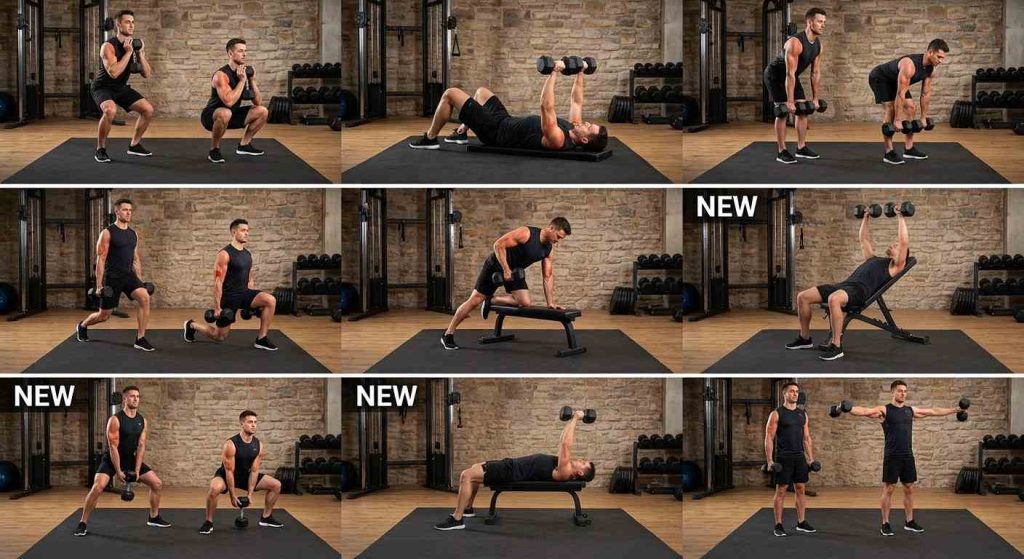
| Exercise | Sets | Reps | Rest |
| Dumbbell Goblet Squat | 4 | 8-10 | 90 sec |
| Dumbbell Bench Press (or Floor Press) | 4 | 8-10 | 90 sec |
| Dumbbell Bent-Over Row | 4 | 8-10 | 90 sec |
| Dumbbell Romanian Deadlift | 3 | 10-12 | 60 sec |
| Dumbbell Shoulder Press | 3 | 10-12 | 60 sec |
| Plank | 3 | 30-45 sec | 45 sec |
Day 2: Hypertrophy Focus
| Exercise | Sets | Reps | Rest |
| Dumbbell Reverse Lunge | 3 | 10-12 each leg | 60 sec |
| Dumbbell Incline Press | 3 | 10-12 | 60 sec |
| Single-Arm Dumbbell Row | 3 | 10-12 each side | 60 sec |
| Dumbbell Lateral Raise | 3 | 12-15 | 45 sec |
| Dumbbell Bicep Curl | 3 | 12-15 | 45 sec |
| Dumbbell Overhead Triceps Extension | 3 | 12-15 | 45 sec |
| Russian Twist | 3 | 15-20 total | 45 sec |
Day 3: Power and Endurance Focus
| Exercise | Sets | Reps | Rest |
| Dumbbell Deadlift | 4 | 8-10 | 90 sec |
| Dumbbell Push Press | 3 | 8-10 | 90 sec |
| Renegade Row | 3 | 8-10 each side | 60 sec |
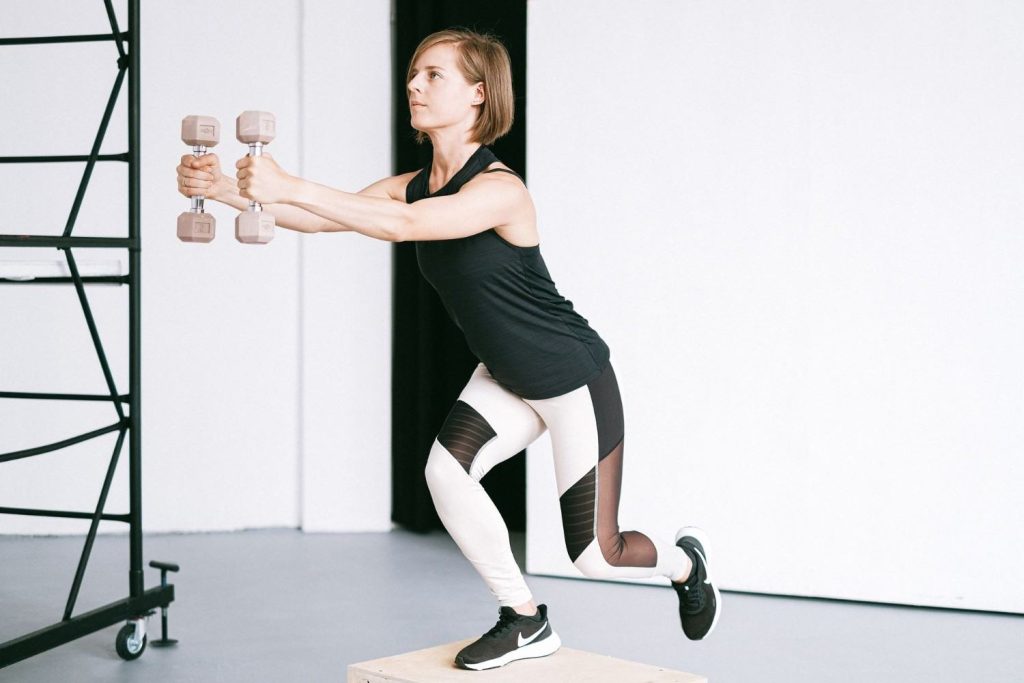
| Dumbbell Step-Up | 3 | 10-12 each leg | 60 sec |
| Dumbbell Chest Fly | 3 | 12-15 | 45 sec |
| Hammer Curl | 3 | 12-15 | 45 sec |
| Dead Bug | 3 | 12-15 each side | 45 sec |
How to Progress Over Time
It’s the progressive overload that will build strength and muscle, not simply training.
- Increase weight once you complete all repetitions in one workout session.
- Add repetitions in case you’re getting close to your max dumbbells.
- Increase the number of sets after a certain period of recovery.
- Keep track of your workouts in a note-taking app or on paper to see how much you’ve progressed so far and beat it next time.
Rule of thumb: If you reach the maximum number of repetitions per set in all working sets during two consecutive training sessions, add weight to the bar.
Warm-Up and Cool-Down
- Warm-up (5-8 minutes): Low-intensity aerobic exercises (stationary jogging, jumping jacks), along with squats, arm circles, and hip openers to prepare your joints.
- Cool-down (5 minutes): Stretching the hamstrings, chest, shoulders, and hip flexors in static positions in order to promote recovery and flexibility.
Nutrition Tips to Support Your Results
Working out three times a week is more effective if complemented with adequate recovery nutrition:
- Make sure you consume enough protein, about 0.7- 1 g per pound of body weight daily to promote muscle repair.
- Do not under-fuel yourself on workout days, as your body requires recovery food.
- Sleep should be prioritized (7-9 hours a day) as recovery mostly occurs during sleep.
- Keep in mind that hydration is crucial, particularly in the mornings or in a warm environment.
The Benefits of a 3-Day Dumbbell Workout Routine
A 3-day dumbbell exercise program serves as a realistic approach for building strength, increasing muscle tone, and achieving fitness. The flexibility that is offered by dumbbells, the ability to train each side separately, as well as the convenience of workouts both at home and in a gym, serve as major advantages of using this equipment.
6 Major Types of Dumbbell Workouts to Engage In
1. Beginners’ Dumbbell Workout
This program includes basic exercises such as the goblet squat, dumbbell rows, and shoulder press with lighter weights. This helps develop the right form, coordination, and confidence before moving on to any more advanced weight training.
2. Chest Dumbbell Workout
This routine focuses on developing your chest muscles with pressing, flying, and pullover movements done from a bench or floor position. This routine will help you build a bigger, stronger, and more defined chest muscle.
3. Dumbbell Upper Body Workout
In this workout, you will perform exercises targeting the chest, back, shoulders, and arms such as presses, rows, curls, and raises. The result is that you will achieve balanced strength in the upper body and muscle definition throughout the torso and arm muscles.
4. Lower-Body Dumbbell Workout
This exercise regimen targets squats, lunges, deadlifts, and step-ups to develop the muscles in the quads, hamstrings, glutes, and calves. This helps to improve your stability and build leg power.
5. Dumbbell Triceps Workout
This exercise routine specifically isolates the triceps using exercises such as extensions, kickbacks, and close-grip presses. This helps to improve your arm strength and development, as well as pressing power for other exercises.
6. Full-Body Dumbbell Workout
This exercise regimen targets all major muscle groups in a single workout through exercises such as squats, presses, and rows. This ensures maximum efficiency during your workouts.
Our 3-Day Dumbbell Workout Plan for Fitness Enthusiasts
A good structure for a three-day dumbbell exercise regimen would allow you to train major muscle groups and give your body sufficient time to rest between training days. Your workouts will include strength training for the upper body, lower body, and the whole body.
Day 1: Chest, Shoulders, and Triceps
| Exercise | Sets × Reps |
| Dumbbell Bench Press | 3 × 10–12 |
| Dumbbell Flyes | 3 × 10–12 |
| Dumbbell Shoulder Press | 3 × 10–12 |
| Lateral Raises | 3 × 10–12 |
| Tricep Dips | 3 × 10–12 |
| Overhead Triceps Extension | 3 × 10–12 |
Day 2: Back, Biceps, and Legs
| Exercise | Sets × Reps |
| Bent-Over Rows | 3 × 10–12 |
| Single-Arm Dumbbell Rows | 3 × 10–12 |
| Goblet Squats | 3 × 10–12 |
| Dumbbell Lunges | 3 × 10–12 each leg |
| Hamstring Curls | 3 × 10–12 |
| Bicep Curls | 3 × 10–12 |
| Hammer Curls | 3 × 10–12 |
Day 3: Full-Body Dumbbell Workout
| Exercise | Sets × Reps |
| Push-Ups | 3 × 10–12 |
| Goblet Squats | 3 × 10–12 |
| Dumbbell Romanian Deadlifts | 3 × 10–12 |
| Dumbbell Shoulder Press | 3 × 10–12 |
| Bent-Over Rows | 3 × 10–12 |
| Bicep Curls | 3 × 10–12 |
| Tricep Dips | 3 × 10–12 |
It is important to choose a weight that will provide you with enough challenge, but also give you enough time to perform the exercise using the correct technique.
How Much Weight Should You Use?
A weight should be chosen that makes the last repetitions of the exercise difficult but still allows for proper technique to be used. It is not necessary to choose a load where each set will lead to muscular failure.
As stated in the 2026 Resistance Training Position Stand of the American College of Sports Medicine, progressive resistance training is highlighted, and momentary muscular fatigue is not always an outcome determinant for healthy adults. For most of the exercises in this program, the 8–12 repetition range seems to be a reasonable choice. For smaller movements, such as lateral raises and curls, the 10–15 range may be effective.
Can You Build Muscle With Only Dumbbells?
Yes. Dumbbells can offer resistance training without having to go to the gym. The 2026 resistance training guidelines from ACSM state that training at home and with simpler equipment can aid in enhancing physical capacity and strength. Dumbbells enable you to do the following exercises:
- Squats
- Lunges
- Presses
- Rows
- Hip hinges
- Carries
- Curls
- Triceps exercises
- Shoulder exercises
The outcomes are determined by training frequency, resistance, type of exercise, recovery, nutrition, and progressive overload.
Can This Workout Help With Fat Loss?
Resistance training may be a component of a fat loss regimen, but resistance training alone cannot dictate the amount of body fat you will lose. Caloric intake, physical activity, sleep, exercise, and other individual factors may affect changes in body composition.
The Physical Activity Guidelines encourage the combination of muscle strengthening exercises together with regular aerobic exercise. Most adults should engage in at least 150 minutes of moderate-intensity aerobic exercise each week plus muscle strengthening exercises for at least two days.
Brisk walking, biking, swimming, or any other aerobic activity of your choice may be done on your non-lifting days.
Who Can Follow This Dumbbell Routine?
The program is appropriate for healthy adults who would like a simple resistance-training routine at home or in the gym. Newbies should start with light weights and concentrate on learning the proper movement patterns. Experienced exercisers can add more resistance or change volume depending on their level of training.
Individuals with an injury, pain problem, medical condition, or any other issues related to the exercises need to consult a properly qualified health and fitness expert before starting the resistance training program.
FAQs
Can I do this workout at home?
Yes. You will require dumbbells and some room for you to do the exercises safely. The bench will enable you to do more exercises, but it is not necessary.
Should I do full-body workouts three days in a row?
For most people, recovery days need to be inserted between their total-body resistance workouts. Monday, Wednesday, and Friday are a simple workout schedule.
How many dumbbell exercises should I do per workout?
About five to seven exercises will be enough for an effective full-body workout. Concentrate on fundamental movements prior to adding more isolation exercises.
Can beginners follow a three-day dumbbell routine?
Yes. Novices have to begin with manageable weights, learn proper technique, and build up the training difficulty progressively.
Conclusion
The well-designed 3-day dumbbell full body workout is an effective way for you to train all parts of your body with minimal equipment. The most important thing here is not complex training exercises. What matters is consistency of the workouts, proper technique, right resistance, recovery period, and progression. An easy workout routine that you will be able to follow consistently will lead you to desired results.