Learn what soccer agility drills are, explore effective exercises, training plans, testing methods, and tips to improve speed, balance, reaction time, and footwork.
Soccer agility exercises are workouts aimed at training soccer players how to maneuver in a fast manner changing direction, speed, and positioning. They involve training movement techniques that players employ while dribbling, defending, pressing, evading their opponents, and responding to any kind of change in the game.
Soccer requires continuous acceleration, deceleration, lateral movement, rapid changes in direction, and sudden bursts of speed. Agility training assists in coordinating all of these movements. An excellent routine will also be beneficial to footwork, body control, reaction time, and movement confidence.
What Are Soccer Agility Drills?
An agility drill in soccer is a planned activity designed to improve the ability of a soccer player to move quickly and maintain body control when changing directions. The drill may use cones, a ladder, hurdles, resistance bands, or any other mark on a field.
In most cases, a soccer player will never run in a straight line during a play. The players run forwards, stop abruptly, run sideways, run backwards, or run in different directions after identifying an opponent. An agility drill simulates all those movements within a training environment.
Key Components of Soccer Agility
Agility training requires a combination of physical skills, not just one particular skill.
| Agility Component | What It Develops | Soccer Application |
| Acceleration | Rapid movement from a stationary or slow position | Chasing a loose ball |
| Deceleration | Controlled slowing and stopping | Preparing for a tackle or turn |
| Change of direction | Fast directional movement | Beating a defender |
| Balance | Body stability during movement | Staying upright after a cut |
| Coordination | Efficient movement between body parts | Dribbling and changing direction |
| Reaction time | Responding quickly to a stimulus | Reacting to an opponent |
| Footwork | Quick and accurate steps | Defensive positioning |
| Body control | Managing movement under pressure | Turning with the ball |
Pros
- Increases speed and reflexes
- Improves balance and body coordination
- Increases fast movements in all directions
- Improves defensive movements
- Improves footwork and coordination
Cons
- Proper techniques and coaching needed
- Causes fatigue due to overtraining
- Requires appropriate training environment
- Becomes monotonous with repetitive drills
- Improper techniques lead to injuries
Change-of-Direction Speed vs. Reactive Agility
Agility training for athletes includes two types:
- Change-of-Direction (COD) speed training consists of planned movements. The athlete knows the position of the cones and where to change directions. Cone weave and 5-10-5 shuttle exercises belong to this category.
- Reactive agility incorporates decision-making. The athlete reacts to an unpredictable stimulus such as partner movement or a called-out color. Mirror exercises and 1v1 shadow training develop reactive agility.
Great athletes need both types. COD exercises ensure proper technique development, while reactive exercises help translate that technique into practice situations.
Why Is Agility Important in Soccer?
In soccer, there are few straight movements. One common study among English Premier League players (Bloomfield et al., 2007) found that each player turned around at least 700 times in one game. Each turn requires stopping, positioning, and accelerating again. Agility training enables you to:
- Outmaneuver opponents with improved cutting ability and fast initial steps from a fake move.
- Defend opponents better by tracking their movements and recovering from being cut around.
- Maintain ball control because improved balance allows you to stay close to the ball when you change direction.
- Avoid injuries since agility teaches you proper ways of landing and cutting. Warm-up routines including these exercises, like FIFA 11+, have reduced injuries in amateur athletes in several studies.
- React quicker by enhancing your awareness and responsiveness.
7 Effective Soccer Agility Drills
The most effective drill is determined by the age, skill level, training objective, and space available to the player. It is recommended that drills begin with slow movements before increasing speed and complexity.
1. Cone Shuffle Drill
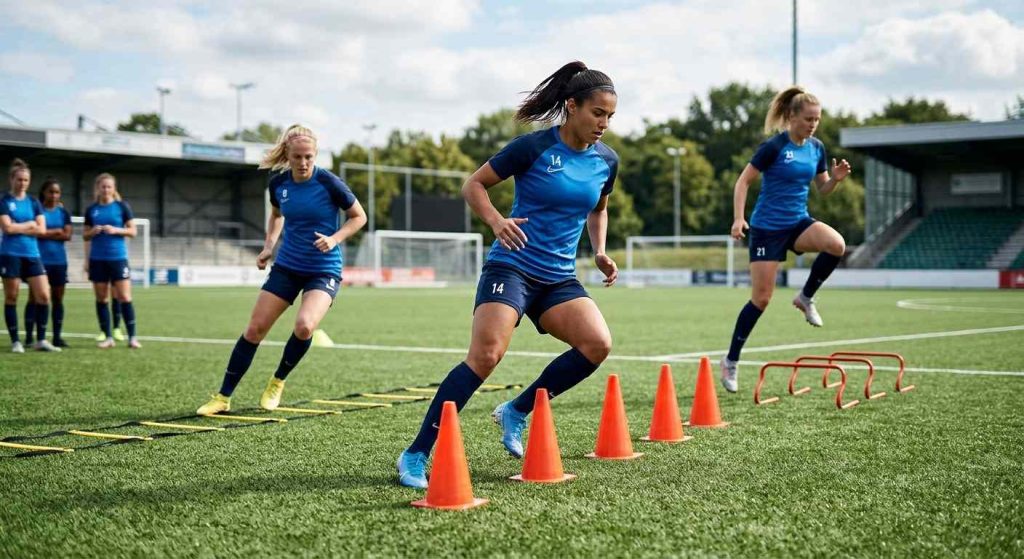
Cone drill is performed with several cones placed several feet away from each other in a straight line. Lateral shuffles between cones must be done while maintaining low body positioning.
2. 5-10-5 Shuttle Run
Three cones must be placed in a row. The drill begins in the middle, then the sprinter sprints five yards to the side. Then he changes direction and runs ten yards past the initial starting position.
3. T-Drill
Four cones form the T-shape. One runs from the bottom of the T, shuffles across the top, moves back through the center, and returns backwards towards the starting position.
4. Box Drill
Position four cones in a square shape. Traverse the box utilizing forward running, lateral shuffles, and backward motion. Try changing your movement pattern each time you perform the drill.
5. Zig-Zag Cone Drill
Line up cones in a diagonal pattern within the training zone. Perform sprints towards each cone, make cuts, and accelerate towards the next cone. Maintain balance when making every directional change and avoid uncontrolled movements.
6. Reaction Agility Drill
Position yourself in an athletic position. Get directed by the coach or partner on how to move. Respond instantly to signals such as verbal instructions, colors, hand signals, etc.
7. Ball Agility Drill
Perform dribbling drills by making direction changes and accelerations into open spaces. Control the ball at all times and advance the drill to include a reaction cue or passive defender.
Sample 20-Minute Agility Session
| Time | Activity |
| 0–5 min | Dynamic warm-up: jogging, leg swings, high knees, lunges |
| 5–10 min | Ladder drills (Drills 1 and 2) |
| 10–15 min | T-Drill and 5-10-5 Shuttle |
| 15–18 min | Dribble-and-Turn Gates |
| 18–20 min | Cool-down and stretching |
Do your agility training 2- 3 times a week, allowing your body one recovery day between intense training days.
Soccer Agility Drills for Different Ages
- Youth players (under 12): Keep your training fun and game-like by using colored markers, relay races, and doing 10- 15-minute training sessions. Work on coordination rather than intensity.
- Teen players (13–18): Resistance bands, hurdles, and timed running are useful additions. Make sure to teach proper landing and cutting techniques to prevent injuries to developing joints.
- Adult and amateur players: Integrate agility training with strength and mobility training. If you have not done agility training before, begin with low volume.
How to Measure Your Agility Progress
Self-assess every 4-6 weeks using the same drill with identical conditions. Common tests are:
- 5-10-5 Pro Agility Shuttle test for lateral quickness.
- T-Test for multidirectional quickness.
- Illinois Agility Test for overall agility and coordination.
Use your best time out of three trials. Make sure to record your performance using a phone to see if you have good body position.
Speed vs. Agility: What’s the Difference?
Many athletes confuse the concepts of speed and agility. Speed allows you to gain an advantage in a head-to-head race to the ball. Agility enables you to gain the advantage once you reach it.
| Factor | Speed | Agility |
| Movement direction | Mostly straight lines | Multi-directional |
| Main goal | Cover distance fast | Change direction fast |
| Key skills | Stride length, stride frequency | Footwork, braking, balance, reaction |
| Decision-making | Low | High |
| Common drills | 20–40 m sprints | Cone weaves, T-drill, mirror drill |
| Match use | Counterattacks, chasing long balls | 1v1 duels, pressing, defending |
Finding Soccer Agility Training Near You
Local soccer academies, clubs, and sports performance centers usually offer speed and agility training classes. When looking for “soccer agility training near me,” make sure that your coach has a coaching license or a strength and conditioning certificate. Make sure that they incorporate ball and reaction training drills into their program, not just ladder and cone drills.
How Often Should Soccer Players Do Agility Drills?
Most players are able to fit their agility training in 2 to 3 times a week, depending on their whole training program, their playing standard, age, recovery, and game schedule.
Agility sessions do not have to be of a long duration. Short bursts with proper rest periods between them may suffice since fatigue may compromise movement performance and quick reaction.
Players must ensure sufficient recovery between repetitions and should not perform agility sessions in cases of fatigue that negatively affects movement execution.
How to Test and Track Agility Progress
Take the test every 4–6 weeks on the same surface, shoes, and warm-up. Get your fastest time out of three trials and video at least one rep to assess form.
| Test | What It Measures | Setup | How to Score |
| 5-10-5 Pro Agility | Lateral cutting speed | 3 cones, 5 yards apart | Best time of 3 trials |
| T-Test | Forward, lateral, and backward movement | 4 cones in a T-shape | Best time of 3 trials |
| Illinois Agility Test | Overall agility and body control | 10 × 5 m course, 8 cones | Best time of 3 trials |
Common Mistakes During Soccer Agility Training
Common ways for players to diminish the effectiveness of their agility training involve concentrating solely on the speed component. They include:
- Cutting corners at cones
- Standing erect
- Uncontrolled footsteps
- Fatigued training
- Improper foot landing
- Ignoring deceleration
- Repeated use of same movement patterns
- Rapid increase of intensity without proper technique
Agility training creates a better form of movement rather than quick movement.
Conclusion
Soccer agility training enables players to develop speed, balance, coordination, reaction time, and the ability to change directions. Cone exercises, shuttle running, T-drill, reaction activities, and ball drills can enable players to get ready for actual match conditions. Soccer players can train two or three times per week with adequate rest and achieve consistent improvement. Players must practice technique first, monitor their performance frequently, and increase difficulty progressively with improvement in movement control.