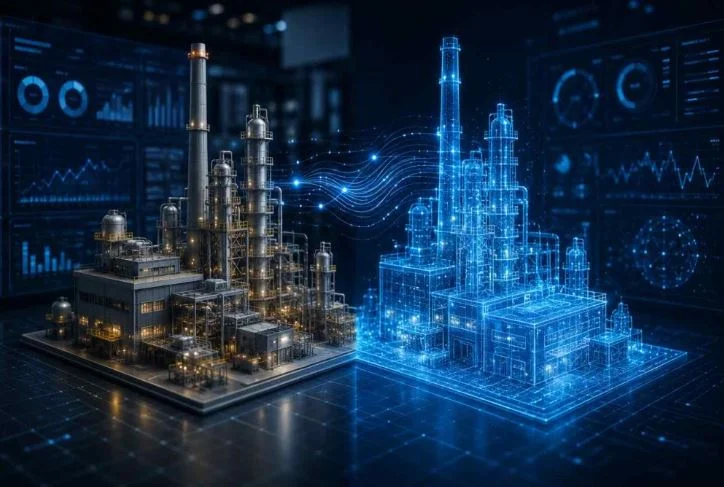
Digital twin technology creates real-time virtual models of systems to improve efficiency, decision-making, safety, and innovation across industries globally.
Digital Twin Technology is the process of creating a virtual model of a physical object, system, or process. It is based on real-time data from sensors that replicates real-world performance in a digital model. This enables the monitoring, simulation, and prediction of behaviors without the physical presence of people. Manufacturing, medical, and engineering sectors commonly use it to boost efficiency, cut expenses, and support better decision-making.
What Is a Digital Twin?
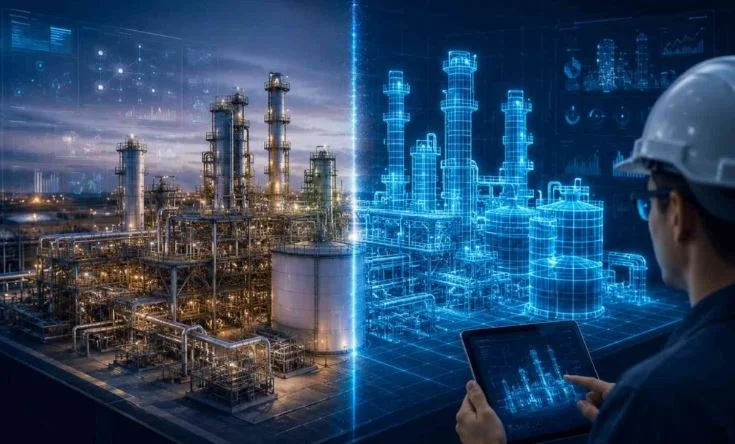
A digital twin is a dynamic digital representation of a physical asset, system, or process. Unlike a simple 3D model, a digital twin can use data from the real-world counterpart to represent its current condition and behavior.
For example, a manufacturer can create a digital twin of a production machine. Sensors can collect information such as temperature, vibration, pressure, speed, and operating hours. The digital model can then use this information to monitor performance, identify unusual patterns, and help engineers evaluate potential maintenance requirements.
Digital twins can represent different scales, including:
- Individual components
- Machines and equipment
- Vehicles
- Buildings
- Production lines
- Factories
- Power plants
- Supply chains
- Infrastructure networks
- Entire cities
A digital twin can also connect multiple individual twins to represent a larger system and the relationships between its components.
Key Components of a Digital Twin
The ideal digital twin comprises several important components:
- Physical Components: The actual physical component that is being replicated, along with all its associated sensors.
- Connectivity Layer: IoT networks, 5G, cloud computing, and similar technologies that facilitate connection between the physical and digital world.
- Data Platform: Cloud or physical platform where a huge amount of data produced by the actual physical entity is stored and processed.
- Virtual Model: The actual digital twin itself, which represents the geometry, physics, chemistry, biology, or behavior of a real entity.
- Analytics/AI Engine: This component is responsible for analyzing the vast amount of data collected and performing machine learning processes.
- User Interface: User interface or visualizations through which users will interact with the digital twin.
How Does Digital Twin Technology Work?
Physical Entity and Data Collection
A digital twin begins with real-world objects (machines and systems) and obtains real-time data on their operations, environment, and performance through a combination of sensors, IoT devices, and tags.
Data Transmission and Integration
Data moves through cloud or edge systems, where these systems clean, process, and merge it with historical data, context, and APIs for easy integration and analysis.
The Virtual Model and Analytics Engine
A virtual model is a simulation, artificial intelligence, and analytics approach to modeling physical systems, forecasting results, conducting scenarios, identifying problems, and making real-time decisions and optimizations.
Types of Digital Twins
Component Twins
Component twins refer to a single part of a system, e.g., a sensor, a motor, or a valve. They help manage performance, identify faults, and facilitate efficient and effective maintenance planning.
Asset Twins
Asset twins are multiple components that are linked together and function as a single unit, such as a machine or vehicle. They continuously explore interactions among parts to maximize overall performance, reliability, and operational efficiency.
System Twins
System twins model whole systems like production lines, factories, or power plants. They can help model and simulate complex interactions, better coordinate these interactions, minimize downtime, and enable large-scale operational decision-making and efficiency.
Process Twins
Process twins are the complete workflow or business processes, e.g., supply chains or manufacturing cycles. They fine-tune operations, evaluation, and resource utilization, along with sequencing, to result in smoother, faster, and more efficient operations.
What Are the Benefits of Digital Twin Technology?
Digital twins can provide operational and strategic benefits when organizations have reliable data and a clear business objective.
Improved Decision-Making
Digital twins bring operational data, historical information, and simulations into one digital environment. Teams can use this information to understand current conditions and evaluate possible outcomes before making changes to physical systems.
Reduced Costs
Predictive maintenance and process optimization can help organizations identify problems before they become expensive failures. Digital testing can also reduce the need for repeated physical prototypes and unnecessary operational experiments.
Improved Safety
Organizations can simulate potentially dangerous situations in a controlled digital environment. Engineers can evaluate equipment behavior, environmental conditions, and operational risks without exposing workers to the physical hazard during the initial analysis.
Better Product Quality
Continuous monitoring can help teams identify changes in equipment performance and production conditions. Early detection can support quality control and reduce defects, inconsistency, and production waste.
Faster Product Development
Engineers can create digital versions of products and test different designs before physical production. This approach can help teams identify design problems earlier and evaluate multiple configurations more efficiently.
Increased Operational Efficiency
Digital twins can reveal inefficient processes, equipment underperformance, resource constraints, and bottlenecks. Organizations can use these insights to improve workflows, equipment utilization, energy consumption, and production performance.
Better Asset Management
A digital twin can provide a centralized view of an asset throughout its lifecycle. Teams can track performance, maintenance history, operating conditions, and other relevant information from design through operation and eventual retirement.
What Are the Challenges of Digital Twin Technology?
Digital twins offer significant opportunities, but implementation also presents technical and organizational challenges.
Data Collection
Real-time collection of high volumes of accurate information from sensors and devices is needed for digital twin systems. Poor data quality and sensor inaccuracies that cause inconsistencies and gaps in data sources make it challenging to collect high-quality data.
Modeling
Making a model of a ‘real system’ in digital form is not simple. Advanced simulations, accurate algorithms, and frequent updates help ensure a virtual twin matches real-world behavior well.
Deployment
The implementation of digital twin technology can be costly and complex. It demands expertise, infrastructure, and integration with existing systems, and is time-consuming and resource-intensive for large-scale deployment.
Security
Digital twins are dependent on connected networks and cloud platforms and, therefore, susceptible to cyberattacks. Maintaining the security of sensitive operational information and the security of the system is one of the greatest challenges that organizations face.
Interoperability
Digital twin systems are frequently required to collaborate with various software, devices, and platforms. With no standard, there is no guarantee of seamless communication and integration between different technologies and systems.
What Industries Are Using Digital Twins?
Manufacturing
In manufacturing, digital twins are common for tracking production lines, forecasting equipment failures, and optimizing production processes. They ensure the consistency of product quality in factories and industrial plants, improve efficiency, and reduce downtime.
Healthcare
Digital twins can model a patient, organ, or medical device. Doctors use them to simulate treatments, improve diagnosis, and create more personalized treatment plans that support better outcomes.
Energy
Digital twins are employed in the energy sector to keep track of power plants, wind turbines, and electrical grids. They enable better energy efficiency, forecasting of equipment failures, and stable and reliable energy production and distribution.
Automotive
Automotive manufacturers are leveraging digital twins in the design, testing, and optimization of their vehicles before they enter production. They are used to replicate engine performance, safety systems, and driving behavior to enhance reliability, safety, and fuel economy.
Aerospace
Digital twins are applied in the aerospace industry for modeling aircraft systems, engines, and flight operations. They enhance safety, cut maintenance costs, and boost performance by monitoring and predicting.
Oil and Gas
Digital twins are used by the oil and gas industry to track drilling operations, pipelines, and refineries. They contribute to the identification of leaks, optimization of extraction processes, and the enhancement of safety in high-risk environments.
Mining
Digital twins are used in the mining industry to monitor equipment, analyse geology, and enhance extraction productivity. They help to mitigate risk, boost productivity, and provide safety in difficult mining conditions.
Construction
In the construction industry, companies can use digital twins to model buildings and infrastructure projects. They improve planning and project execution, reduce errors, and help teams complete projects on time and within budget.
Applications used in digital twin technology
Product design and development
Digital twins help designers create and test virtual product models, improving design accuracy, shortening development time, and identifying imperfections before physical manufacturing.
Operational efficiency
They streamline daily operations, optimize performance, and enable industries to effectively manage resource utilization and reduce waste, enhancing productivity and efficiency.
Preventive maintenance
Digital twins continuously monitor equipment, predict equipment failures before they happen, schedule maintenance, minimize downtime, and maximize the life of machinery and industrial assets.
Risk assessment
They simulate various scenarios to figure out possible dangers, which helps businesses assess safety measures, avoid accidents, and decide with minimized uncertainty.
Training and simulation
Digital twins create realistic virtual environments for training. Workers can practice skills safely, improve their understanding, and gain experience without risking damage to real equipment.
Digital Twin vs Simulation
Digital twins and simulations have similar characteristics, but they do not serve exactly the same purpose. A traditional simulation often models a scenario using predefined conditions. Engineers can change inputs and observe possible outcomes.
A digital twin can connect the model to real-world data and update its representation as the physical system changes.
| Digital Twin | Traditional Simulation |
|---|---|
| Can use live operational data | Often uses predefined data |
| Represents a specific physical counterpart | May represent a theoretical or planned system |
| Can update continuously | Usually runs for a defined scenario |
| Supports operational monitoring | Often supports design and testing |
| Can support predictive analytics | Focuses mainly on modeled scenarios |
| May include feedback mechanisms | Usually does not control the physical system |
AWS explains that simulations commonly support design and offline optimization, while digital twins can provide interactive environments that update with real-world information.
Digital Twin Technology and Artificial Intelligence
Artificial Intelligence plays the role of making the digital twin an intelligent system that makes decisions instead of a mere monitoring device. Machine learning algorithms learn from patterns in the twins’ data stream and recognize anomalies that human operators might miss. Deep learning models can accurately predict the remaining lifespan of different parts.
AI-based generation is also starting to take part in this process, with the ability for engineers to ask questions in natural language about digital twins (“How will pressure change in Tank B if Pump 3 operates at 80 percent capacity for 12 hours?”).
Integration of AI technology and digital twins has resulted in the creation of cognitive digital twins that are capable of not just mimicking and simulating physical objects but also analyzing their actions, learning from them, and making autonomous decisions as well.
What Technologies Enable Digital Twins?
Digital twin systems often combine several technologies rather than relying on one platform.
| Technology | Role in Digital Twins |
|---|---|
| IoT sensors | Collect real-world data |
| Cloud computing | Store and process large datasets |
| Edge computing | Process data closer to equipment |
| Artificial intelligence | Detect patterns and support predictions |
| Machine learning | Learn from historical and operational data |
| 3D modeling | Represent physical assets visually |
| Simulation | Test different scenarios |
| Data analytics | Analyze asset and system performance |
| APIs | Connect software and data sources |
| Digital platforms | Manage models, data, and workflows |
NIST describes digital twins as an integration of modeling, sensing, connectivity, data, and computational capabilities rather than a single standalone technology.
How Are Digital Twins Used in Industry 4.0?
Digital twins support the broader Industry 4.0 approach by connecting physical assets, data, software, automation, and intelligent decision-making. A smart factory, for example, can connect machines through IoT sensors, send operational data to a digital platform, analyze that data with AI, and use digital models to evaluate production scenarios. This connected environment can help manufacturers move from reactive operations toward predictive and data-driven processes.
Future of Digital Twin Technology
The future of digital twins is very much dependent on progress in the field of AI, 5G, and the Internet of Things. In time, digital twins will gain greater accuracy, autonomy, and widespread usage.
In the coming years, we can expect:
- Fully automated industrial operations
- Smart cities with efficient infrastructure monitoring systems
- Healthcare simulation models designed for individuals
- Supply chains optimized for efficiency
Digital twin technology will become one of the pillars in the development of the concept of Industry 4.0, which is based on the integration of the physical and digital worlds.
Is a digital twin the same as a 3D model?
No. A 3D model primarily represents the visual structure of an object or environment. A digital twin can combine a model with real-world data, relationships, analytics, simulations, and operational information.
Are digital twins used in healthcare?
Yes. Healthcare-related digital twin applications can involve medical devices, organs, facilities, research, and patient-specific modeling. These applications require careful validation, privacy protection, and appropriate clinical oversight.
Final Thought
Digital twin technology converts physical systems into virtual intelligent representations through the use of real-time data. The application of digital twin technology makes it easier to make decisions, increase efficiency, enhance safety, and foster innovation. Although there are some problems, such as data accuracy and security, its increasing incorporation with AI and IoT makes it inevitable in future industrial applications. How do you think Digital Twin technology will impact your industry in the coming years? Let us know in the comments below!