
Best exercises for speed to improve acceleration, explosive power, running technique, agility, and reaction time with practical workouts and training tips.
Speed training exercises can improve your ability to generate power, move efficiently, and maintain proper running mechanics. Sprint drills, strength exercises, plyometrics, hill sprints, and acceleration runs can help you develop greater speed when you use proper technique and allow enough recovery. Sprinters, football players, basketball players, other athletes, and recreational runners can benefit from speed training. Your exercises should match your sport, fitness level, and specific performance goals.
Why Speed Training Matters
Speed enables athletes to travel distances faster, be the first one to get the ball, gain separation from an opponent, change directions, and react to movement. Runners will perform better in track and field because of better speed. Speed enables athletes on the field and on courts to accelerate, be quick, jump, and change direction.
Running speed exercises can condition the body to generate force at high speed. Speed exercises that are explosive can increase acceleration capacity from a static or slow position. Training an athlete’s speed should include such components as technique, strength training, sprinting, recovery, and progressive overload.

15 Best Exercises for Speed
1. Short Sprint
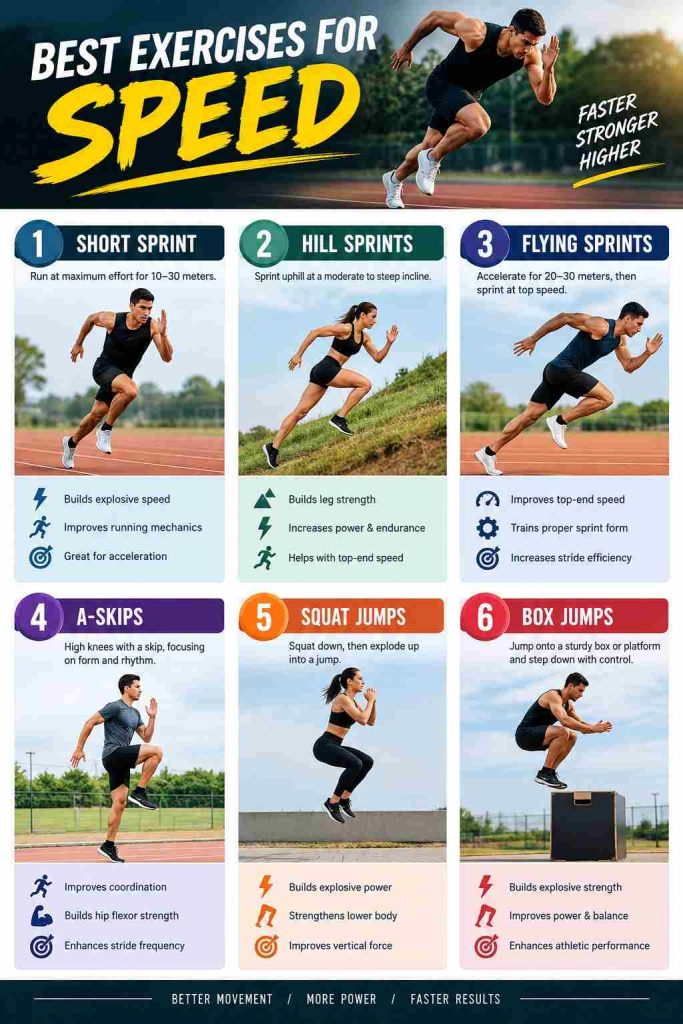
Sprint training increases acceleration, speed, and leg drive. The sprinting distance should vary from 10 to 30 meters. Strong arm swings and good body position are necessary. Speed drills will improve the ability to sprint.
2. Hill Sprints
Running up hills builds leg strength and helps develop acceleration and sprinting power. One should run up a hill for 10-20 seconds, walk down, fully recover, and do the drill again. Hill sprints can be included in sprinting exercises.
3. Flying Sprints
Flying sprints help attain maximum speed of running. One should gradually accelerate for 15-30 meters and sprint for another 15-30 meters at high speed. These speed exercises work well for athletes.
4. A-Skips
A-skips help enhance sprint mechanics, coordination, knee drive, and rhythm. One needs to stand straight, lift knees quickly, keep feet active, and move forward. A-skips can be used prior to speed exercises.
5. Bounding
Bounding helps develop horizontal force, coordination, and explosive leg power. One needs to drive the knee forward and push off the opposite foot. One needs to control movements and use short distances in explosive power exercises.
6. Squat Jumps
Squat Jumps increase leg power and explosive strength. Start with squatting to a comfortable position, then jump up explosively, land gently, and return to the starting position. Include them when training lower body speed through various drills.
7. Box Jumps
Box Jumps will enhance explosive power and strength in your lower body. Do a powerful jump onto a sturdy box and land softly before coming down. They will go well with acceleration and speed training exercises.
8. Lateral Bounds
Lateral Bounds will help you develop sideways power, balance, coordination, and single-leg stability. Bound sideways from one leg to the other leg, apply a strong effort, and touch the ground safely. They will assist with agility training exercises and faster running.
9. Single-Leg Hops
Single-leg hops will help you develop ankle strength, balance, coordination, and lower body power. Apply yourself in hopping forward for a short distance. They will assist in plyometric exercises and faster running training exercises.
10. Resisted Sprints
Resisted sprints increase acceleration needs and produce horizontal forces. Do them using a sled or an appropriate resistance along with good sprint technique. Resisted sprints are useful for acceleration training and sprint speed improvement.
11. Agility Ladder Drills
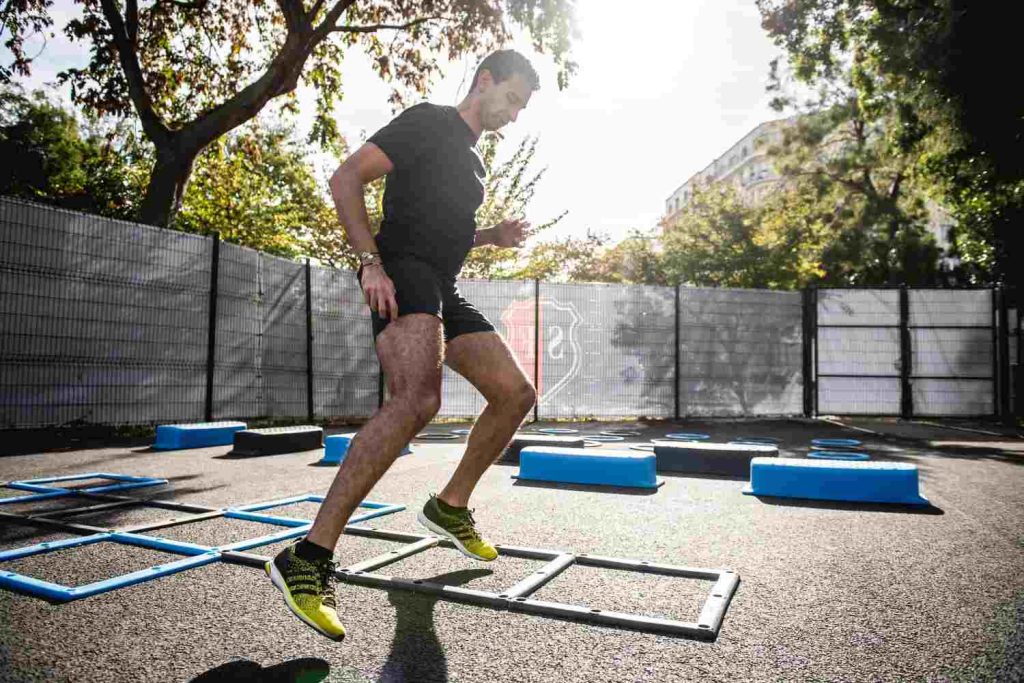
Agility ladder workouts enhance foot speed, coordination, rhythm, and body control. Train on lateral moves, two-feet-in drills, and shuffles. These workouts can be used to build up foot speed along with sprinting.
12. Shuttle Runs
The shuttle run enhances acceleration, braking ability, directional changes, and conditioning. Sprint from one marker to another, turn around, and continue again. They make great speed conditioning and speed-related agility workouts.
13. Hill Bounding
Hill bounding involves high-power running with an incline involved. Extend your knees out, and drive your body forward through the running motions. The repetitions should be short since it is a tough drill for the legs.
14. Medicine Ball Throws
Throws using a medicine ball create explosive strength using the hips, torso, and upper body. These include rotational throws, overhead throws, chest throws, or scoop throws. They are good for fast-twitch muscle strength training and explosive strength training.
15. Reaction Sprints
Reaction sprints involve acceleration and making decisions. You should start in an athletic posture and react promptly to the visual or auditory signals from your partner. They help to develop reaction speed and quickness.
Exercises for Beginners
A beginner does not require an advanced sprint routine. Such a basic routine might involve the following:
| Exercise | Sets | Repetitions |
| High knees | 2 | 20 seconds |
| A-skips | 2 | 20 metres |
| Short sprints | 4 | 20 metres |
| Squat jumps | 3 | 5 |
| Broad jumps | 3 | 4 |
| Easy cooldown | 1 | 5–10 minutes |
Make sure you get adequate rest during the sprint and jump exercises. The aim should be quality of movement rather than exhaustion.
Best Exercises for Speed and Explosiveness
For explosive performance as your primary objective, consider mixing sprint training with plyometric and strength workouts. Some combinations worth trying are:
- Short sprints
- Hill sprints
- Broad jumps
- Box jumps
- Bounding
- Squat jumps
- Sled pushes
- Squats
- Romanian deadlifts
Sprint training develops the capacity to move quickly. Plyometric training develops rapid force generation. Strength training contributes to building the necessary physical base for powerful movement.
How to Warm Up Before Speed Training
1. Easy Movement
Take a walk or run slowly for 5 to 10 minutes. In this way, you will warm up your body and prepare your muscles for further training.
2. Dynamic Mobility
Add exercises such as leg swings, lunges, hip circles, and ankle actions in your warm-up session. These exercises will help to increase flexibility in your joints and prepare your legs for sprinting.
3. Running Drills
Perform high knees, A-skips, butt kicks, and sprints. These exercises will help to develop your coordination, technique, and rhythm before your speed exercises.
4. Progressive Accelerations
Perform 2-3 sprints quickly, but increase your pace gradually. Start slowly and do not exert maximum effort before you are ready for it.
Important Tip
Do not start your first sprint at maximal pace. Increase your efforts gradually to allow muscles and joints to adapt to increasing physical activity.
Sample Weekly Speed Training Plan
The following is an easy-to-follow framework that combines these elements to train for athletic speed:
| Day | Focus |
| Monday | Sprint mechanics + acceleration drills |
| Tuesday | Strength training (leg exercises for speed) |
| Wednesday | Rest or light mobility work |
| Thursday | Plyometrics + agility drills |
| Friday | Max-velocity sprints + reaction drills |
| Saturday | Active recovery or sport-specific practice |
| Sunday | Full rest |
It’s a perfect combination of sprinting skills, strength training, and rest, which doesn’t allow overtraining but builds speed.
Speed Conditioning Workouts for Beginners
If you’re new to structured training, speed workouts for beginners should start simple:
- Start with some technique work such as A-skips and high knees.
- Then do some short sprints (10-20m) at 80-90% effort.
- Do some basic bodyweight plyometrics such as squat jumps.
- Gradually increase the intensity by doing resisted sprints and max velocity sprints.
It’s very important that speed conditioning workouts are conducted at your current fitness level. Any advanced exercises will bring you nothing but an increased chance of getting hurt.
Strength Exercises for Faster Running
Strength and speed have a very close relationship. Exercises used to increase speed through strength training consist of the following:
- Trap bar deadlifts to enhance overall power
- Bulgarian split squats for one-legged strength
- Hip thrusts to develop power in the glutes, an important muscle group for running fast
- Exercises that target core muscles such as plank and anti-rotation press, which will keep the trunk stable when moving at high speeds
Increasing strength in these areas will help in every other type of speed training for an athlete because a stronger body is capable of producing greater force in every stride.
Safety Tips for Speed Training
High-speed exercises put considerable strain on the muscles, ligaments, joints, and nerves of your body. Here are some general rules that you need to keep in mind:
- Warm up before running.
- Begin with shorter distances.
- Slowly increase the amount of training.
- Use a safe and even surface.
- Have appropriate shoes.
- Keep proper form.
- Take rest between repetitions.
- Discontinue training if you feel unusual pain.
- Gradually advance when doing plyometric training.
Any athlete who comes back after suffering an injury must adhere to advice from a properly qualified healthcare or sports specialist.
FAQs
How long does it take to improve sprint speed?
For any athlete, improvement will be seen within 6-8 weeks in terms of training, 2-4 times per week. Full development of one’s speed as an athlete may take several months to even one year, depending on their initial physical condition.
Can strength training alone make you faster?
Strength training is important in developing the strength necessary for speed, but it will be even more efficient when combined with sprints and plyometric training. Developing strength through speed training will help develop power and application of power during sprints.
What is the best exercise for explosive speed?
Box jumps and bounding may be considered two of the best exercises for building explosive speed because they teach the body how to apply its maximum force in the shortest amount of time possible.
How often should I train for speed?
Speed training should be carried out 2-4 times a week, and each training day should be spaced at least 48 hours apart, as this will give your muscles and your nervous system time to recover.
Do agility drills improve straight-line speed?
Agility training helps to enhance your ability to change directions quickly and your body coordination. It is crucial, however, that you should also incorporate agility and linear speed training if you want to achieve overall speed.
What exercises help with a faster first step?
Falling starts, wall drills, and resisted sprints performed with either a resistance band or a sled help to improve your ability to move quickly from your first step.
Are plyometrics safe for beginners?
Newbies to this type of training will benefit from doing some low-impact exercises such as skipping and hopping first before moving on to box jumps and depth jumps. Learning proper landing technique is also important.
What are good exercises to improve reaction time?
Mirror drills, partner reaction sprints, and randomized cone drills are exercises that will help you to improve reaction time. This is because these drills will make your nervous system analyze the signal and react instantly.
Conclusion
Some of the best workouts for gaining speed include sprinting, strength, plyometric, agility, and reaction training. Sprinting will offer you the acceleration required for speed, while jumping and bounding will help you develop explosive power. Warm-up, proper technique, proper progression of workouts, and enough recovery time will enable you to safely acquire speed. Perform exercises that suit your sport and fitness needs, and keep track of your improvement. With proper training, you can improve your speed, running, and reactions.


Pingback: Best Indoor Exercises for a Rainy Day: Complete Guide - Mtech content