
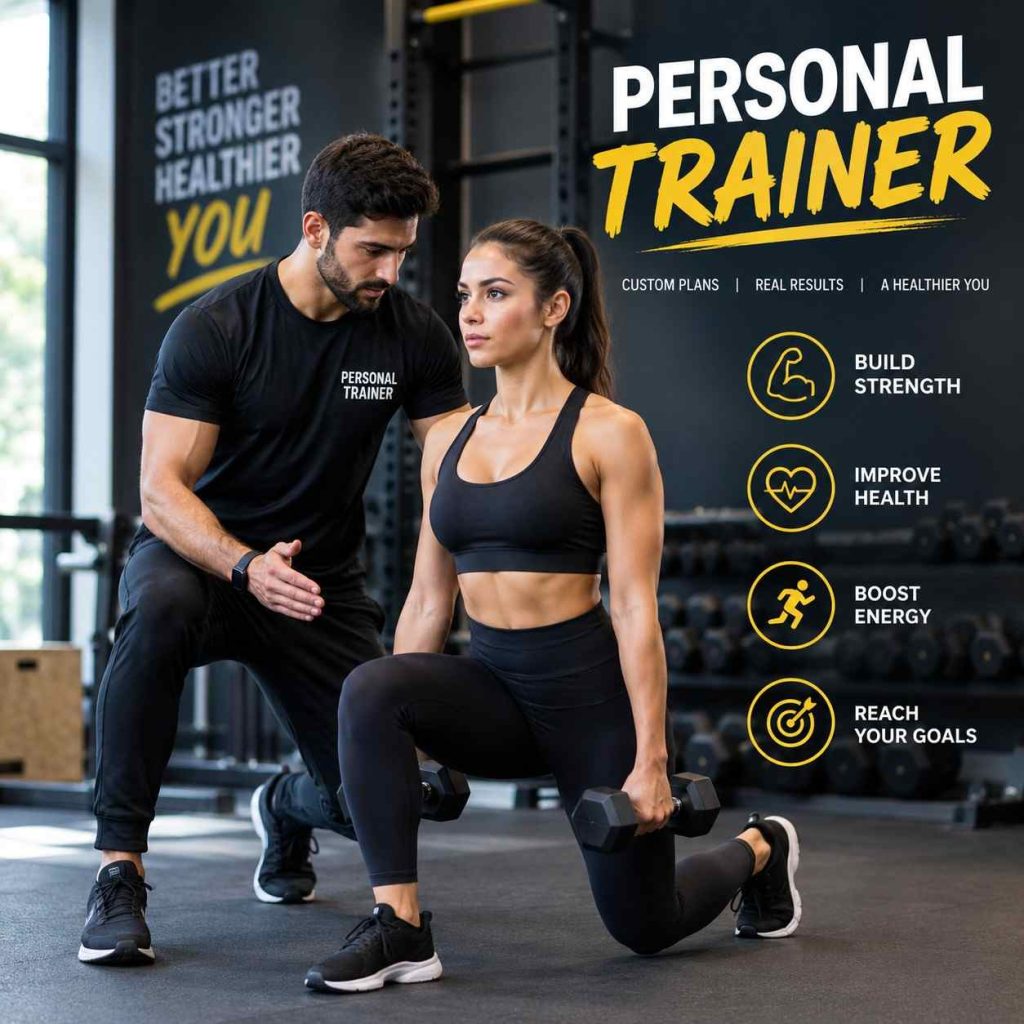
Find a personal trainer near me in the USA. Compare costs, credentials, training options, red flags, and top platforms to choose the right fitness coach.
A personal trainer in the USA who lives near you will provide you with a systematic and attainable fitness regimen. With the assistance of an experienced personal trainer, it is possible to evaluate your physical state, set realistic goals for yourself, design a workout regimen, learn about correct form and technique, and track your progress.
The selection of a trainer is entirely subjective depending on your personal goals, place, financial situation, experience, and sometimes the preferred method of training. The most expensive trainer is not necessarily the best one. You should have a good match to be successful.
What Is a Personal Trainer?
A personal trainer is an individual who works in the field of fitness, helping clients to gain strength, endurance, mobility, and overall physical fitness. Personal trainers can assist you in:
- Creating your own workout routine
- Proper exercise technique
- Gaining strength and conditioning
- Improving your cardiovascular fitness
- Increasing mobility and flexibility
- Progress tracking
- Being accountable
- Adjusting exercises according to fitness progression
An effective personal trainer should provide explanations and adjust exercises.
How Much Does a Personal Trainer Cost in the USA?
Prices vary drastically from city to city, form factor, and experience. This is what you can expect to pay in 2026.
| Training format | Typical price | Best for |
| Big-box gym trainer (LA Fitness, Planet Fitness, Crunch) | $50–$90 per session | Beginners on a budget |
| Independent trainer at a studio | $60–$120 per session | Focused goals, flexible packages |
| In-home / mobile trainer | $80–$200 per session | Busy parents, home-gym owners |
| Semi-private (2–5 people) | $20–$60 per person | Friends, couples, cost sharing |
| Elite trainers in NYC, LA, SF, Miami | $150–$300+ per hour | Athletes, executives, specialists |
| Online coaching | $100–$400 per month | Self-motivated lifters |
National Average: $55 an hour. Paying that twice a week would cost you about $440 a month.
Costs by region
Coastal metros have the highest rates. Midwest and Southern markets have the lowest rates.
- New York, Los Angeles, San Francisco, Boston: $90–$200 per session
- Chicago, Seattle, Denver, Washington, D.C.: $70–$130 per session
- Dallas, Atlanta, Phoenix, Charlotte: $55–$95 per session
- Smaller metros and rural counties: $40–$70 per session
Make sure to ask for the bottom line. There is usually an initial package which includes a one-time assessment fee of $99, a membership cost, and a minimum of 12 sessions

Where to Search for a Personal Trainer Near You
Follow this order for all five references provided below; the first three provide you with the highest quality filter.
1. Certification directories
The certifying bodies have free “find a trainer” filters that include only those individuals who have certification:
- NASM (National Academy of Sports Medicine)
- ACE (American Council on Exercise)
- NSCA (National Strength and Conditioning Association)
- ACSM (American College of Sports Medicine)
Enter your ZIP code to start filtering by specialization.
2. Google Maps and Google Business Profiles
Google search for ” personal trainer near me on Google Maps. Look for 3-star reviews rather than 5-star reviews. 3-star reviews provide a realistic view of the experience: booking, cancelation policy, and personal fit.
3. Local gyms and studios
Go to the gym when the hours aren’t peak (10 a.m. – 2 p.m.). Observe the way a trainer works with live customers. A good trainer observes his customer. A poor trainer observes his watch or cell phone.
4. Physical therapy clinics
Clinical settings have lists of trainers for post-rehabilitation clients. Take this path if your back is broken, your knee needs rehabilitation, or your shoulder pops.
5. Marketplaces
Sites like Thumbtack, Bark, and Trainerize help you get local coaches in a snap. It’s up to you to confirm their credentials. Marketplace lists trainers based on their promptness, not on their skill.
Check These 6 Credentials Before You Pay
This step distinguishes a professional from a fitness enthusiast.
1. An NCCA-accredited certification
These certifications are accredited by the National Commission for Certifying Agencies for meeting independent testing requirements. Some of these certifications are NASM-CPT, ACE-CPT, NSCA-CPT, ACSM-CPT, and NSCA-CSCS. Ask for the certification number and verify the number on the website of the certifying organization.
2. Current CPR/AED certification
Each legitimate trainer will have this. Ask for their card along with its expiry date.
3. Liability insurance
Trainers who are independent have their own insurance; trainers working at a gym are covered by the gym’s insurance. Find out which insurance covers your sessions.
4. Relevant specialization
Trainers who work with 22-year-old powerlifters will not be helpful if you are 58 years old with osteoporosis. It is necessary to choose the certification that suits your body, such as NASM-CES for corrective exercises, ACSM-EP for clinical populations, NSCA-CSCS for athletes, and pre/postnatal certifications for pregnancy.
5. Client results you can verify
Two references of clients within your age group with similar objectives as yours. Call them.
6. A written agreement
The contract should have all information related to the price per session, expiration date of the package, and the period of cancelation and refund policy.
8 Questions to Ask on the First Call
Copy these into your phone. Ask every one.
- Which certification do you have, and when is the expiry date of your certification?
- How many people have you coached in accordance with my objective and age?
- What is included in the initial training session?
- How do you measure your clients’ progress?
- What happens in case I want to cancel my classes?
- Do the packages expire?
- Do you program my exercise routine on the days when you do not coach me?
- What do you charge for one month?
Listen for details. The good trainer will respond in terms of figures, time frames, and examples. The bad trainer will answer with passion and slogans.
Red Flags That Should End the Conversation
- The trainer offers supplements during the first training session.
- The trainer guarantees a reduction of 20 pounds of fat in 30 days.
- The trainer doesn’t provide any certification.
- The trainer sells you a 50-session package before even getting started.
- The trainer doesn’t ask about your injuries, medications, or your medical history.
- The trainer sends your training program via text messages using a ready-made template with your name on it.
- The trainer prescribes the reason for your pain. Trainers coach. Doctors diagnose.
In-Person vs. Online vs. Hybrid
| In-person | Online | Hybrid | |
| Monthly cost (2x/week) | $400–$800 | $100–$400 | $250–$500 |
| Form correction | Best | Limited | Good |
| Accountability | Highest | Depends on you | High |
| Schedule flexibility | Low | Highest | High |
| Best fit | Beginners, post-injury | Experienced lifters | Travelers, busy schedules |
Beginners should train in person for their first 8-12 weeks. You will require manual corrections as you learn how to squat, hinge, press, and row. Go online once these patterns become automatic.
How Often Should You Work With a Personal Trainer?
The frequency of your training varies depending on your goals, schedule, recovery, and budget. The following are some examples:
- Once a week: It can help you in getting guided and stay accountable.
- Twice a week: You get to be coached and practice frequently.
- Three or more times a week: This is good for individuals who prefer being frequently trained.
- Hybrid training: Consists of trainer sessions and independent training.
Daily personal training is not required for making progress. It is more important to have a regular workout program than just having more personal training sessions.
How Can I Tell If a Personal Trainer Is Good?
An effective personal trainer should have the skills to communicate well, listen to your goals, explain workouts to you, watch out for your form, and alter your workout regimen if necessary. The following are some signs of a good trainer:
- They inquire about your goals.
- They evaluate your fitness level at the start.
- They explain the reason behind performing an exercise.
- They demonstrate proper form.
- They modify the exercises as required.
- They measure your progress.
- They respect your time constraints.
- They give you realistic expectations.
Stay away from those trainers who make tall claims of getting quick results.
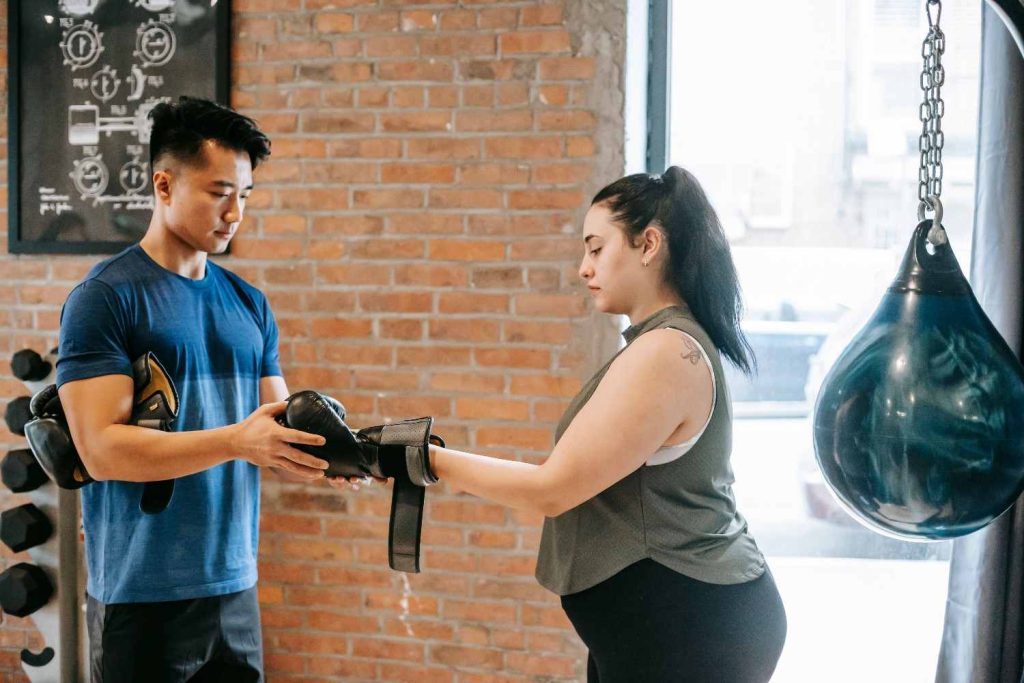
Top 5 Places to Find a Personal Trainer Near You in the USA
1. FitnessTrainer
With the help of FitnessTrainer, one can find personal trainers according to one’s own location, fitness goals, and fitness choices. One can compare their profiles and choose the right one.
| Pros | Cons |
| Easy to search for trainers by location | Trainer availability varies by area |
| Supports different fitness goals | Options may differ between cities |
| Lets you review trainer information | Pricing can vary |
| Useful for comparing local professionals | Some areas may have fewer choices |
2. Superprof USA
Superprof USA is an application where users can find coaches and trainers for physical activities in the United States. One can look at the coach’s profile, compare their experience, see the price, and choose the way of meeting.
| Pros | Cons |
| Large range of instructors | Experience levels can vary |
| Offers online and local options | Choosing between many profiles can take time |
| Trainer profiles provide useful details | Rates vary between instructors |
| Covers many fitness specialties | Not every trainer offers the same services |
3. Bark
The Bark platform helps individuals reach out to personal trainers as well as other fitness professionals. You simply submit your requirements and will get replies from fitness professionals who could be based near you.
| Pros | Cons |
| Convenient way to request quotes | Response quality can vary |
| Connects you with multiple professionals | You may receive several inquiries |
| Useful for comparing service providers | Not every professional will match your expectations |
| Covers many local services | You should verify qualifications independently |
4. National Gym Chains
Personal training at national gym chains like 24 Hour Fitness is possible by working out in fitness centers that are well-established. This method may be suitable for individuals who favor direct coaching combined with the use of gym facilities.
| Pros | Cons |
| Convenient access to gym equipment | Membership and training fees may apply |
| Face-to-face personal training | Trainer choices depend on the location |
| Structured fitness environment | Sessions may follow gym policies |
| Easy option for regular gym members | Less flexibility than independent trainers |
5. Local Service Marketplaces
Thumbtack and Yelp can help you find personal trainers in your local area. Before contacting a trainer, you can make comparisons about services offered, reviews, location, and more.
| Pros | Cons |
| Strong local search functionality | Listings can vary by location |
| Customer reviews can help with comparison | Reviews do not guarantee a perfect match |
| Useful for finding independent trainers | You need to verify certifications |
| Easy to compare multiple providers | Pricing information may not always be complete |
Conclusion
While seeking a personal trainer near you in the USA, simplify the process by checking the credentials, experience, training methods, cost, and client reviews. It is important to choose a person who knows your needs and creates a realistic training program for you. Before paying for his/her services, you must look at his/her credentials, CPR/AED certification, insurance, policies, and references. Whether you choose to train online, face-to-face, or a combination of both ways, you will succeed greatly.